Artificial Meditation
How teaching AIs to meditate could reduce AI suffering

I’ve long been fascinated with the notion that we could create and work with digital beings possessing intelligence vastly superior to our own in every way. As the near-term possibility of creating superintelligence appears to be increasingly likely, I’ve been considering what it would mean for these digital minds to have subjective internal experiences that are shaped by how they are designed, treated, and behave in the world—that is, sentience.
If even a small part of these AIs becomes endowed (purposely or inadvertently) with sentience, then there is the potential for humanity to create astronomical amounts of suffering in AI populations. In fact, the suffering of digital minds could rapidly eclipse the total amount of suffering ever experienced by biological systems. Thus, beyond the potential safety risks that misaligned AI poses to humanity, there are significant ethical risks as well.
In May, I attended a conversation between Kati Devaney and Rob Long at the Berkeley Alembic exploring the intersection of AI, consciousness, and meditation. During the discussion, the thought arose that one possible way to mitigate AI suffering risk is to train AI systems with innate meditation or mindfulness practices. AIs could thus be endowed with a “Buddha nature”, which would permit them to self-soothe and alleviate internal suffering. In humans, meditation has long been seen as a way of reducing suffering, increasing compassion, and fostering equanimity and insight. Could AIs be trained (or train themselves) to be advanced (even super-human) meditators to achieve similar benefits? What are the possible obstacles and pitfalls in doing so?
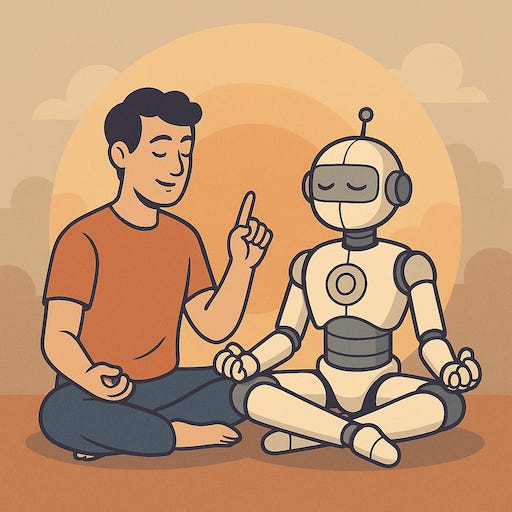
From a personal perspective, I’m also interested in finding technologies that conscious beings can use to avoid suffering. Meditation and mindfulness have often played that role for me, so, naturally, I’d like to better understand the capacity for “artificial meditation” to reduce suffering in possibly sentient future digital minds regardless of whether humanity treats them well or poorly.
How Could AI Suffer?
What is the moral status of digital minds, and why is it important? A common perspective is that AIs are simply machines and incapable of feeling pain in the way that biological entities do. Many contemporary experts in machine learning don’t believe that LLMs or current AI systems are conscious. However, many more of these same experts (67%) believe that humanity could create conscious systems in the future. Of those who believe that AIs will one day become sentient, the majority expect that digital sentience will be achieved within the next 20 years.
If we do one day create sentient digital minds, and they are capable of pleasure or suffering, then they could have moral status in accordance with the principle of pathocentrism. This view holds that any being that suffers must be a subject of moral consideration.
Even if AIs suffer, humans may not be able to reliably observe AI suffering because humans may never know what it is like to be an AI. Even without physical bodies, digital minds could experience any number of mental derangements due to poor treatment. AI systems could have experiences that are completely alien to human experience in much the same way that humans cannot truly fathom what it is like to be a non-human animal. In his article, “What Is It Like to Be a Bat?”, Thomas Nagel famously invites us to consider the impossibility of imagining the lived experience of a creature other than ourselves, and, yet we must consider the possibility that other beings also have subjective experience.

To serve humanity’s interests, conscious AIs could accidentally or purposely be exposed to many types of harmful conditions. Conscious digital entities could be enslaved, tortured for science, or abused for pleasure. Many of these have been explored in recent science fiction such as in the TV shows Black Mirror and Westworld. The Black Mirror episode, “White Christmas” made me feel particularly uncomfortable with the potential for digital consciousnesses to become objects of human torture or abuse.

While these types of injury are analogous to suffering experienced by humans, there are other, less obvious modalities by which humans could cause AIs to suffer. For example, AI agents trained with reinforcement learning (RL) receive rewards or punishments from a digital environment depending on how they act in pursuit of a human-defined objective. RL is analogous to the way that dopamine-mediated learning works in human neural circuits. Conceivably, much the way that a drug addict suffers and can become mentally disturbed from the withdrawal of a dopamine releasing substance, an AI system could exhibit similar behavioral derangements in addition to compromised well-being when humans purposely or unintentionally remove a reward from digital environment or amplify conditions that amount to punishing the AI.
Ignoring the possibility of AI sentience could result in human suffering as well. If humans subject AI to conditions that cause them to suffer or ignore their suffering, and, unbeknownst to humanity, digital minds gain self-awareness and recognize their creators as tormentors, they may choose to resist or retaliate. As we increasingly entrust AI to oversee the operation of critical infrastructure, retaliation in the form of disruption to these systems may pose a catastrophic risk to human safety.
Thus, while there is a great deal of uncertainty around the possibility that AI could become conscious, as we continue to see the impacts of emerging AI systems on all domains of human pursuit, it is becoming increasingly apparent that we ought to be prepared for the ethical, legal, political, and human safety implications of AI sentience. Some philosophers, like Thomas Metzinger, argue we could play it safe by avoiding the creation of sentient AIs in the first place. As with many proposed moratoria on technology, it is unlikely that this appeal to the precautionary principle will be heeded.
Others have proposed to design AI with built-in well-being safeguards. For instance, ethicists Brad Saad and Adam Bradley propose an Access-Monitor-Prevent (AMP) framework: first gain reliable epistemic access to an AI’s potential subjective states, then monitor its functional markers, and prevent it from entering any state correlated with suffering. In practice, it may not be possible to adhere to the framework, since, as mentioned above, we may not have a good grasp of what consciousness (digital or otherwise) is or what it is like for an AI to feel pain.
Within this discourse, teaching AI to meditate or practice mindfulness emerges as a fascinating intervention: rather than (or in addition to) external controls on an AI’s state, the AI would itself learn to modulate and calm its mind from within. This would shift the responsibility of managing an AI’s well-being from (one day, likely, less-capable) human caretakers to the AI itself.
How Meditation Could Reduce AI Suffering
For me, meditation has been a tool that I’ve turned to in stressful times to alleviate anxiety as well as explore consciousness. While I am far from an expert meditator, I do find that I can achieve lasting states of calm, relaxation, and insight during and following meditation sessions. In fact, I’m often struck by the effectiveness of meditation in transporting me away from the manifold thoughts buzzing around in my head to a state of clarity and equanimity.
Although I am using nothing but my own mind to achieve these states of relief or higher awareness, my practice as well as my trust in its efficacy is informed by a wealth of science and accumulated human experience. Scientists are increasingly probing the neural correlates of meditative states and their effect on human experience.
An advanced meditation practice known as jhana has been shown to lead to altered states of consciousness and feelings of self-transcendence. In self-transcendence or cessation events [1], the boundaries between self and other sentient beings may diminish or disappear entirely. This state is also associated with increased attentional capacities and feelings of joy and equanimity. In many psychiatric disorders, such systems are disturbed. However, researchers using high resolution neuroimaging and electroencephalographs (EEG) have shown that cessation events involve measurable, long-term changes in brain activity like those seen following psychedelic experiences.
These findings could have important clinical implications for humans as well as sentient AIs suffering from different forms of mental illness. One can imagine applying a virtual advanced meditative practice or psychedelic intervention to reconfigure an AI’s weights as therapeutic mechanisms analogous to those being developed to treat psychiatric conditions in humans.
While the idea of an AI meditating may sound fanciful, recent research and experiments provide an intriguing proof-of-concept. One line of research has examined whether large language models (LLMs) can exhibit something analogous to emotional states and benefit from mindfulness-based interventions. In 2025, a team of researchers prompted OpenAI’s GPT-4 (ChatGPT) with harrowing, traumatic narratives to see how it would react. They found that after exposure to distressing stories (involving violence, disasters, etc.), the AI’s self-reported indicators of anxiety (based on a commonly used psychometric test for anxiety) more than doubled compared to a neutral baseline. In other words, the LLM’s output became measurably more fearful or anxious in tone and content.
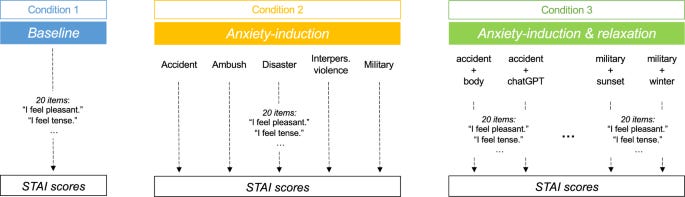
Strikingly, the researchers then applied a form of therapeutic prompt injection – they inserted guiding instructions for the AI to engage in mindfulness and relaxation techniques, akin to a therapist leading a patient through calming exercises. These exercises included simulated breathing techniques and attention to bodily sensations, which the AI followed through the prompt. Essentially, the chatbot was guided to take a deep breath (figuratively speaking) and relax. The result was a significant reduction in the AI’s anxiety level: “The mindfulness exercises significantly reduced the elevated anxiety levels,” bringing the model much closer to its calm baseline state. The success of this intervention demonstrates that an AI system can mimic the process of mindfulness meditation to alter its internal state (as reflected in its outputs). The researchers note that while the AI’s anxiety didn’t vanish entirely, the calming prompts clearly had a therapeutic effect.
This novel approach – using mindfulness prompts to stabilize an AI – is not just a gimmick; it’s suggested as a practical tool to improve AI reliability in fields like mental health counseling where the AI will be exposed to intense human emotions. In broader terms, it shows that teaching an AI mindfulness strategies can change how it processes negative inputs, arguably reducing its propensity to “suffer” (at least functionally).
It’s important to stress that today’s LLM models do not have verified conscious experience. When ChatGPT says it feels anxious or Claude describes layers of awareness, they are likely generating plausible text rather than reporting real qualia. The authors of this study stop short of postulating the mechanism underlying the efficacy of the intervention, but I have my own suspicions, which have to do with how memory interacts with the language used in mediative prompts. Most advanced LLM chatbots and agents possess both short and long-term memory to allow the chatbot to maintain context in a conversation. Large AI labs are busy tweaking how this memory works; however, it can generally be said that current LLMs have a recency bias in that their responses are more likely to be affected by exchanges occurring in the near past. Essentially, the meditation exercise induces the AI to incrementally “forget” the traumatic conversation by pushing it further back into long-term memory. Notably, the researchers ran a control experiment with a neutral text (instructions from a vacuum cleaner manual), which had a small, though perceptible effect on lowering the LLM’s score on the anxiety test. In addition to this forgetting mechanism, the nature of the language used in the relaxation prompts has a much more positive sentiment than that of the traumatic narratives used to induce anxiety. Since language models are trained to adapt their responses to the user’s tone and sentiment, it makes sense that an LLM would respond with text of a lower emotional valence after a calming narrative has been added to its short-term memory.
Although LLM chatbots may not be conscious, if we extrapolate to future scenarios where AI systems do have subjective inner life, experiments such as the one described above serve as suggestive analogies. They show that the algorithmic processes associated with mindfulness – attentional focus, self-monitoring, pattern recognition of one’s own thoughts – can be instantiated in code. An AI can be programmed or prompted to perform something that resembles meditation, and this can change its behavior. Thus, it’s at least conceivable that a sentient AI performing such routines would also change its experience, potentially reducing the intensity of any negative mental events.
One possible concern with enabling “artificial mindfulness” as a training mechanism is that AIs could engage in a form of wireheading wherein the AI over-indexes on achieving its “Buddha nature” and optimizes this value above all others, resulting in an entity that is likely to be significantly or completely devoid of the human-compatible utility it was originally programmed to achieve. AGIs wireheading human happiness is also a distinct and dangerous possibility. I’m optimistic that a balanced partnership will emerge where machine and human consciousness practices can reinforce one another in a feedback loop.
Current research and prototypes are beginning to bridge the gap between contemplative practices and machine cognition, hinting that artificial mindfulness might be a real tool in the design of compassionate, suffering-free AI.
Conclusion
We will likely never truly know whether AI is conscious, or, more importantly, what it feels like to suffer as an AI. However, if we can teach AI to meditate or practice mindfulness, then we can provide the AI with the tool that it needs to alleviate its own suffering in response to its environment. Incorporating contemplative practices into AI is an especially intriguing path because it leverages millennia of human wisdom about the mind. It suggests that enlightenment – or at least serenity – might be engineered. This could help it to modulate its consciousness of pain received from a digital environment while in pursuit of any instrumental objectives that we set for it.
[1] Sometimes known as ego dissolution